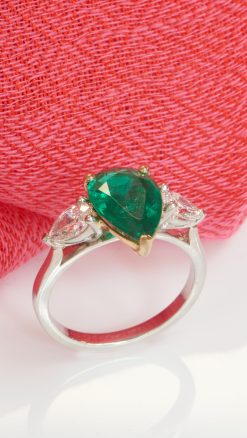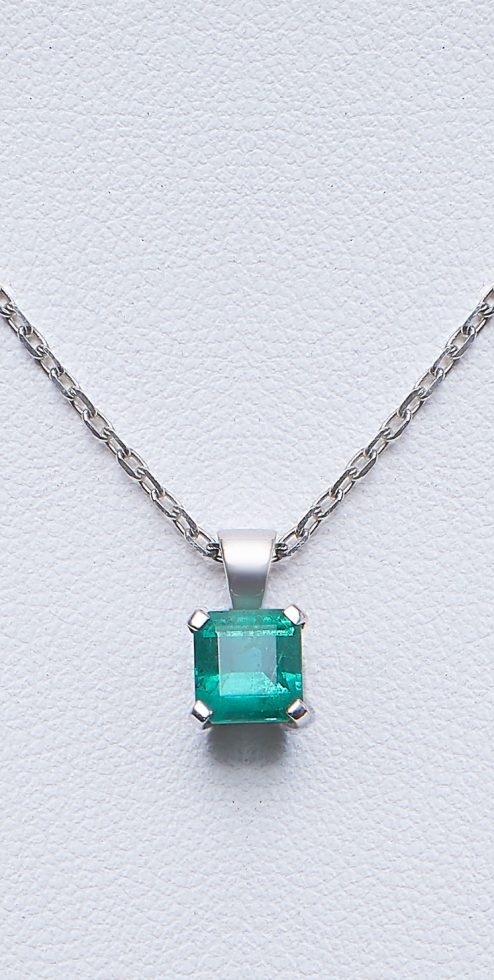
Precious emerald and 18ct gold necklace from Hatton Garden: Natural Princess Cut Emerald Solitaire Pendant, One Carat: best price, valuation certificate, 100% moneyback guarantee


Original price was: £3,600.00.£1,795.00Current price is: £1,795.00.
A classic precious gem piece from Hatton Garden the Emerald Princess Cut Pendant is a picture of timeless beauty. It is designed to highlight the allure of a single natural hand-cut emerald of a full 1 carat, a stunning intense green of power and depth.
The setting of 18 carat white gold offers contemporary style as well as classic elegance, and an 18ct white gold chain adds to the effect.
Fully hallmarked in England, it arrives in a smart case for presentation. The emerald diameter is approx 5mm square, the chain is 16in.
RRP £3,600. CCUK £1,795.
As with all our precious jewellery this beautiful emerald jewel carries a full 100% moneyback guarantee and an insurance valuation certificate at the full retail value (not the Club price, which is always significantly lower).
Emeralds, More Valuable Even Than Diamonds: read on for details
Emeralds, More Valuable Even Than Diamonds:
Emeralds have the most beautiful, most intense and most radiant green that can possibly be imagined: emerald green. Inclusions are tolerated. In top quality, fine emeralds are even more valuable than diamonds.
The Incas and Aztecs of South America, where the best emeralds are still found today, regarded the emerald as a holy gemstone. However, probably the oldest known finds were made near the Red Sea in Egypt. Having said that, these gemstone mines, already exploited by Egyptian pharaohs between 3000 and 1500 BC and later referred to as ‘Cleopatra’s Mines’, had already been exhausted by the time they were rediscovered in the early 19th century.
Written many centuries ago, the Vedas, the holy scriptures of the Indians, say of the precious green gems and their healing properties: ‘Emeralds promise good luck … ’; and ‘The emerald enhances the well-being …’. So it was no wonder that the treasure chests of Indian maharajas and maharanis contained wonderful emeralds. One of the world’s largest is the so-called Mogul Emerald. It dates from 1695, weighs 217.80 carats, and is some 10cm tall. One side of it is inscribed with prayer texts, and engraved on the other there are magnificent floral ornaments. This legendary emerald was auctioned by Christie’s of London to an unidentified buyer for US$2.2m in 2001.
Emeralds have been held in high esteem since ancient times. For that reason, some of the most famous are to be seen in museums and collections across the world. The New York Museum of Natural History, for example, has an exhibit in which a cup made of pure emerald which belonged to the Emperor Jehangir is shown next to the ‘Patricia’, one of the largest Colombian emerald crystals, which weighs 632 carats. The collection of the Bank of Bogota includes five valuable emerald crystals with weights of between 220 and 1,796 carats, and splendid emeralds also form part of the Iranian National Treasury, adorning, for example, the diadem of the former Empress Farah. The Turkish sultans also loved emeralds. In Istanbul’s Topkapi Palace there are exhibits with items of jewellery, writing-implements and daggers, each lavishly adorned with emeralds and other gems.
The lively luminosity of its colour makes the emerald a unique gemstone. Really good quality is rare, with inclusions often marring the evenness of the colour—signs of the turbulent genesis which has characterised this gemstone. Fine inclusions do not diminish the high regard in which it is held. On the contrary: even with inclusions, an emerald in a deep, lively green still has a higher value than an almost flawless emerald whose colour is paler.
Affectionately, and rather poetically, the specialists call the numerous crystal inclusions, cracks or fissures which are typical of this gemstone ‘jardin’. They regard the tender little green plants in the emerald garden as features of the identity of a gem which has grown naturally.
Emeralds from Zimbabwe are among the oldest gemstones anywhere in the world. They were growing 2600 million years ago, whilst some specimens from Pakistan are a mere 9 million years old. From a chemical-mineralogical point of view, emeralds are beryllium-aluminium-silicates with a good hardness of 7.5 to 8, and belong, like the aquamarine, to the large gemstone family of beryls.
Pure beryl is colourless. The colours do not occur until traces of another element are added. In the case of the emerald, chromium and vanadium are mainly responsible for the colour. Normally, these elements are concentrated in different parts of the Earth’s crust to beryllium, so the emerald should, strictly speaking, not exist at all. But during intensive tectonic processes such as orogenesis, metamorphism, emergences and erosion of the land, these contrasting elements found each other and crystallised out to make one of our most beautiful gemstones.
The tension involved in the geological conditions conducive to the above processes produced some minor flaws, and some major ones. A glance through the magnifying-glass or microscope into the interior of an emerald tells us something about the eventful genesis of this unique gem: here we see small or large fissures; here the sparkle of a mini-crystal or a small bubble; here shapes of all kinds. While the crystals were still growing, some of these manifestations had the chance to ‘heal’, and thus the jagged three-phase inclusions typical of Colombian emeralds were formed: cavities filled with fluid, which often also contain a small bubble of gas and some tiny crystals.
Logically enough, a genesis as turbulent as that of the emerald impedes the undisturbed formation of large, flawless crystals. For this reason, it is only seldom that a large emerald with good colour and good transparency is found. That is why fine emeralds are so valuable. But for the very reason that the emerald has such a stormy past, it is surely entitled to show it—that is, as long as only a fine jardin is to be seen, and not a rank garden which spoils colour and transparency.
Colombia continues to be at the top of the list in terms of countries in which fine emeralds are found. Emeralds were mined here by the Incas in pre-Columbian times. In economic terms, the most important mine is at Coscuez, where some three-quarters of Colombia’s emerald production now comes from. Colombian emeralds have an especially fine, shining emerald green unimpaired by any kind of bluish tint. The colour may vary slightly from find to find. This colour is so highly esteemed in the international emerald trade that even obvious inclusions are regarded as acceptable.
Fine emeralds are also found in Zambia, Brazil, Zimbabwe, Madagascar, Pakistan, India, Afghanistan and Russia, with Zambia, Zimbabwe and Brazil in particular having a good reputation for fine emeralds in the international trade. Excellent emerald crystals in a beautiful, deep emerald green and with good transparency come from Zambia (where some of the Club emeralds are mined). Their colour is mostly darker than that of Colombian emeralds and often has a fine, slightly bluish undertone.
While hardness protects the emerald to a large extent from scratches, its brittleness and fissures can make cutting, setting and cleaning difficult. Even for a skilled gem cutter, cutting emeralds presents a challenge, firstly because of the high value of the raw crystals, and secondly because of the frequent inclusions. This does not detract from the cutters’ love of this gem. Indeed, they have developed a special cut: the emerald cut. The clear design of this rectangular or square cut with its bevelled corners brings out the beauty of this valuable gemstone to the full, while protecting it from mechanical strain.
Emerald rings should always be taken off before the wearer puts his or her hands in water containing cleansing agent.
Because the emerald is not only one of the most beautiful gemstones, but also one of the most valuable, there are innumerable synthetics and imitations. How can you protect yourself from these ‘fakes’? The best way is to buy from a specialist in whom you have confidence. Large emeralds should only be purchased with a report from a reputable gemological institute.
One more piece of advice on the purchase of an emerald: while diamonds generously scintillate their fire in sizes below 1 carat, you should go for larger dimensions when acquiring a coloured gemstone. There are some lovely pieces of jewellery with small coloured gems to set decorative accents, but emeralds, like other coloured gemstones, do not begin to show that beautiful glow below a certain size. How large ‘your’ emerald ends up will depend on personal taste, and budget. Really large specimens of top quality are rare. This means the price of a top-quality emerald may be higher than that of a diamond of the same weight.
For more emerald jewellery designs in the CountryClubuk Jewel Vault, please click here.
Only CountryClubuk Members may order. Not yet a Member? Click here to view the advantages. Click here to see what Members say about the Club. Click here to join before you order!
PLEASE READ: CountryClubuk Club Rules and Terms and Conditions
PLEASE READ: CountryClubuk Club Rules and Terms and Conditions
Related products